GLZR Group

Private equity deal flow:
6 channels. One clear search.

In brief

Private equity deal flow is the stream of potential acquisitions and investments reaching a firm. Combine banker and broker relationships, professional referrals, operating networks, industry activity, direct owner campaigns and inbound opportunities. Judge each source by relevant new companies and established owner interest, with duplicates removed.

Before an introduction, distinguish the buyer’s criteria, the owner’s interest and the buyer’s readiness.

. Updated 26 November 2026. Sources checked 26 November 2026.

GLZR perspective

A familiar network can still leave gaps.

A banker sends a company that fits your mandate. Then a second intermediary sends the same company. Your inbox is busier, but your search has not become broader. Private equity deal flow is the stream of potential investments reaching a firm. To improve it, track which relevant businesses you can reach, what is known about owner interest, and whether your team can move the conversation forward.

GLZR’s view is that a sourcing campaign needs a defined job alongside the buyer’s existing network. That job might be reaching owners in an overlooked region, finding businesses outside familiar referral circles, or following up with owners whose timing has changed. A larger contact list alone does not establish that the job was done.

Yale’s 2020 note on programmatic acquisition argues for maintaining both marketed and proprietary sourcing channels. Its discussion concerns repeat acquirers adding to an existing platform. We use that narrower context as background, rather than treating it as a current market statistic or a rule for every buyer.

Research context: On the Nature of Programmatic Acquisition Strategies: How to Source Deals (2020). Checked 26 November 2026.

This guide is GLZR’s editorial framework for organizing a search. It is not a ranking of channel returns. For names and scale, see the private equity firm directory; for provider selection, compare deal sourcing companies and platforms.

The channel shortlist

Six ways an opportunity reaches your team.

01

Bankers and business brokers

Join relevant sale processes.

Send a current acquisition brief to intermediaries whose mandates fit it. State your business model, geography, size measure and the types of situations you can evaluate. When a teaser arrives, record the company or a temporary confidential identifier, the source and the response deadline.

A marketed opportunity can reach several buyers. Establish the process and information requirements rather than assuming that a familiar intermediary means limited competition.

What to record: Measure relevant unique companies received and whether your team responded before the stated deadline.

02

Accountants, lawyers and other professional referrals

Reach an owner through an existing relationship.

Help trusted contacts recognize a fit without expecting them to run your acquisition search. A short description of the businesses you seek is easier to use than a broad request for anything interesting. Ask whether an owner has agreed to an introduction before exchanging sensitive details.

A professional’s suggestion that an owner might sell is different from the owner expressing interest. Treat it as a referral to explore.

What to record: Record the referring relationship, permission for contact and the owner’s response when established.

03

Portfolio companies and operating relationships

Find targets connected to the operating thesis.

Ask the operating team which capabilities, locations or customer needs an acquisition could address. Separate an attractive supplier relationship from a business the platform could actually integrate. For an add-on search, explain who would manage the acquired operation.

Commercial familiarity does not establish ownership, financial fit or willingness to sell. It may also create sensitive relationships that need a careful approach.

What to record: Record the acquisition rationale and the person who will assess operational fit.

04

Industry events and associations

Develop relationships and improve market coverage.

Use conferences, trade shows and industry communities to learn how a market is organized and who participates. Capture the company and the substance of the conversation, then assign a next step. A stack of business cards should not become a list of assumed sellers.

Attendance is evidence of participation in an industry. It is not evidence that the company is for sale. Agree an appropriate reason to continue the conversation.

What to record: Record relevant new companies and agreed follow-ups, keeping general networking separate from sale discussions.

05

Targeted owner campaigns

Approach companies that fit a defined search.

Translate the acquisition brief into a researchable target group, check existing relationships and exclusions, and contact the appropriate owners. The message should explain why a conversation may be relevant to that business. Ask about interest instead of presenting a database match as a seller.

An owner may fit the brief and decline. Another may be curious but not considering a transaction. Direct contact also does not prove exclusivity or a lower purchase price.

What to record: Record research fit, owner response, stated timing and the next step separately. GLZR builds campaigns around the buyer’s criteria and gathers initial information before introductions.

06

Inbound enquiries and deal networks

Make it easier for relevant opportunities to reach you.

A clear acquisition page and a current network profile help owners and intermediaries understand what to bring you. Route incoming opportunities to someone who can assess them. Compare the information received with the same criteria used for outbound sourcing.

Different networks serve different participants. Check who submitted the opportunity, what has been screened and whether it is already in your pipeline.

What to record: Record origin, duplicate status and the reason an opportunity passed or failed your initial screen.
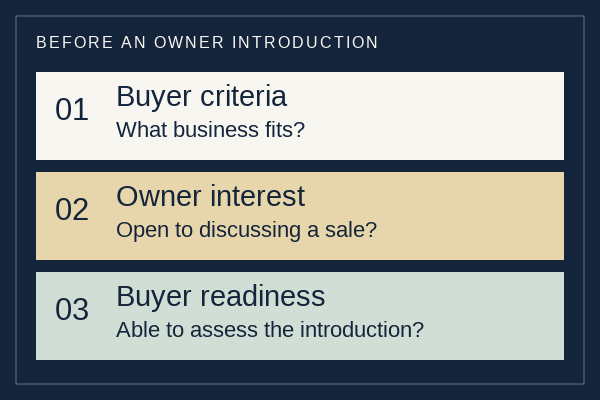
Before the introduction

Keep coverage, interest and readiness separate.

Different records support different decisions.
RecordWhat it establishesNext question
Research targetA company appears relevant from the information reviewed.Which required criteria remain unknown?
Owner responseAn owner has replied, with the meaning recorded in context.Is a sale discussion relevant, or was the reply about something else?
Qualified introductionThe agreed initial criteria and introduction conditions have been checked.What does the buyer need to evaluate next?
Buyer readinessThe buyer has a responsible deal lead and a route to its next decision.Can the buyer progress an appropriate opportunity now?

A reply saying “tell me more” should not automatically become a ready-to-sell owner in the report. Likewise, a strong target should not disappear merely because one datum is missing. Record the missing information and the next question. Use the acquisition criteria guide to define the screen, and the proprietary sourcing checks to review what a sourcing label actually establishes.

Your acquisition search

Give the next sourcing channel a specific job.

At a recurring pipeline review, look at each source’s new relevant companies, repeat companies, owner conversations and unresolved questions. Assign someone to the next step. If a channel produces many names but few useful conversations, inspect the targeting, message and follow-up before buying more volume.

Also check the buyer’s side. An introduction may be premature when the team cannot assess the business or agree who will make the next decision. Timing is a joint problem: the owner’s willingness and the buyer’s capacity need separate answers.

GLZR builds targeted campaigns around acquisition criteria, contacts owners and gathers initial information before introductions. The buyer and its advisors remain responsible for valuation, due diligence, financing, documentation and closing. Read GLZR’s deal sourcing process and current engagement terms.

The free proof of concept ends after 3 qualified meetings are held or 30 days, whichever comes first. Trial meetings remain free; paid continuation is agreed in writing. Read the current terms and qualification details.

Questions

Questions about private equity deal flow.

What is private equity deal flow?

Private equity deal flow is the stream of potential investment or acquisition opportunities reaching a firm. It can come through intermediaries, referrals, operating relationships, industry activity, direct owner contact and inbound channels.

How can a private equity firm improve deal flow?

Define the acquisition brief, identify gaps in current coverage, assign a sourcing channel to those gaps and measure new relevant companies after removing duplicates. Track owner interest and the buyer’s ability to act separately from company research.

Does off-market deal flow mean there are no competing buyers?

No. A direct owner conversation does not establish exclusivity or reveal every other buyer discussion. Ask about the current sale process and record what is known, unknown and dated.

Should a buyer stop using brokers when adding direct sourcing?

That is not necessary. Direct sourcing can address gaps alongside banker, broker and professional relationships. Evaluate each channel against the acquisition brief and the work it contributes.